


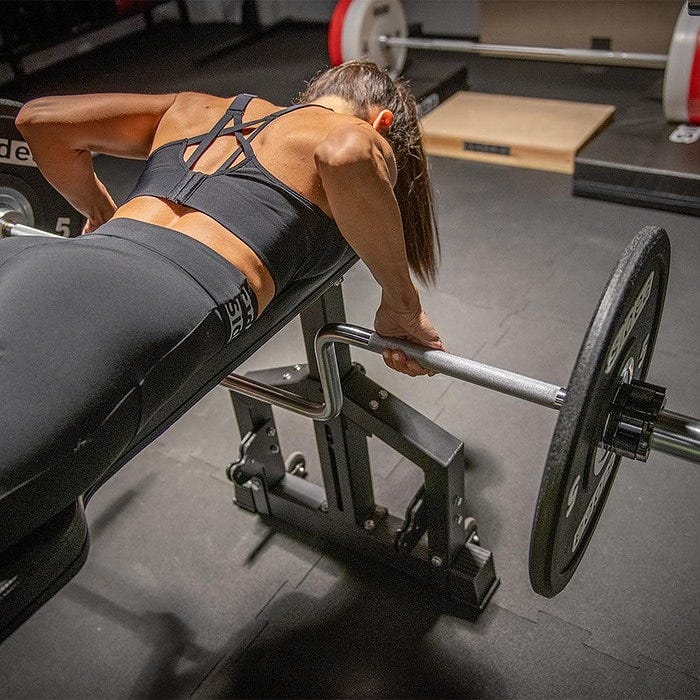
Researchers tested muscle excitation in the prone barbell row using three ranges of motion: full, upper half, and lower half. They found small to medium differences only in latissimus dorsi and trapezius transversus, with inconsistent patterns across measures. This matters because it shows range tweaks with fixed time under tension change back muscle activation a little, giving lifters simple options for upper back work
Aim
The study measured surface electromyography (sEMG) in trapezius transversus, rear deltoid, latissimus dorsi, and biceps brachii during prone barbell rows at 10RM loads. Researchers compared mean and peak excitation across full ROM, upper-half ROM, and lower-half ROM. They standardised time under tension at 2 seconds concentric and 2 seconds eccentric to focus on range effects.
Methods
Sixteen trained men, average age 28, weight 81 kg, with 9 years lifting experience, did two sessions a week apart. First session set 10RM for each ROM using a machine like a Smith setup on a prone bench, grip 1.4 times shoulder width. Second session recorded sEMG during 10 reps per ROM after maximum voluntary isometric contractions for normalisation. Custom stops defined partial ROMs; data filtered and analysed with ANOVA.


Results
Lower-half ROM used the heaviest load at 70 kg, full at 49 kg, and upper-half at 44 kg. Latissimus dorsi mean excitation is highest in the upper-half ROM. Trapezius transversus peak excitation is lowest in the upper-half ROM. The rear deltoid and biceps showed no differences.

Key Takeaways
When time under tension is controlled, changing the range of motion in the prone barbell row produces only small to moderate differences in back muscle activation, and those differences are inconsistent across measures.
For most lifters, this means ROM selection in the prone row is less critical than the broader training variables most coaches already prioritise, such as load, volume, and proximity to failure.
A few specific patterns are worth noting:
Latissimus dorsi showed higher mean activation in the upper-half ROM compared to the full and lower-half ROM. If lat development is the priority, the upper portion of the row may offer a marginal edge.
Trapezius transversus showed lower peak activation in the upper-half ROM compared to both the full and lower-half. Lifters targeting upper back thickness may want to avoid restricting the row to the top half.
Lower-half ROM required the heaviest absolute load at 10RM intensity. For strength-focused blocks, this range allows more weight on the bar at matched relative effort.
Rear deltoid and biceps brachii showed no meaningful differences across any range. ROM selection will not change how hard those muscles work.
The researchers stress these results should be treated as reference data. EMG does not directly predict hypertrophy or long-term strength gains, so decisions about ROM should also account for joint comfort, training history, and the specific muscles a lifter is prioritising in a given training block
Reference
Fischer, J., Burger, C., Seguel, J. M., Rodoplu, C., Paternoster, F. K., Tilp, M., & Konrad, A. (2025). Impact of different ranges of motion in the prone barbell row on muscle excitation. Journal of Electromyography and Kinesiology, 83, 103025. https://doi.org/10.1016/j.jelekin.2025.103025

You can also find me at dannyleejames.com for stories, personal training insights, and coaching.