


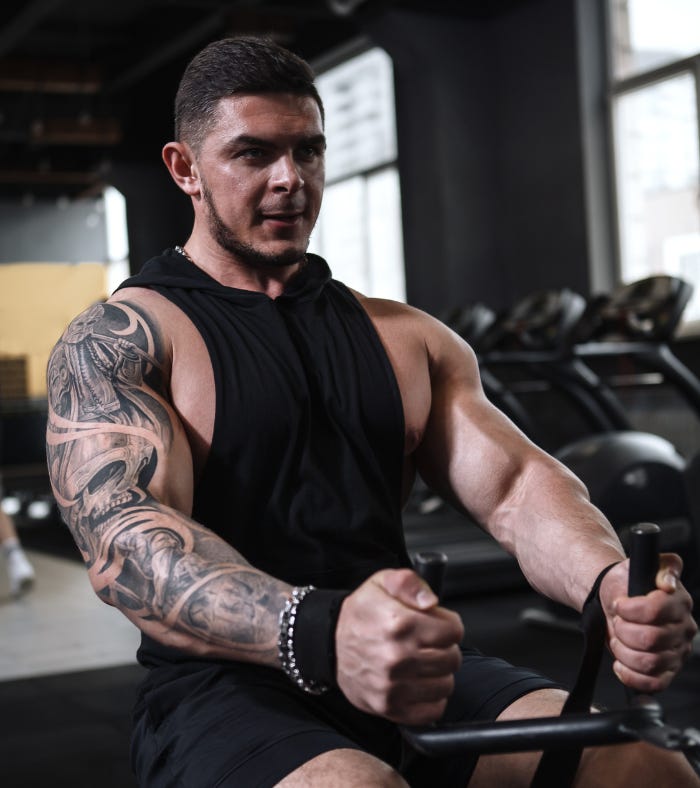
Researchers from the University of Milan used high-density surface electromyography (HD-sEMG) to map exactly where and how hard key back muscles fire during two seated row variations: narrow-grip and wide-grip. Fourteen resistance-trained men performed at their 8-rep max loads.
Aim
To compare muscle excitation between the narrow grip seated row (narrow-SR) and wide grip seated row (wide-SR) using HD-sEMG, which goes beyond standard EMG by mapping the spatial distribution of muscle activity across a grid of electrodes.
Unlike standard single-electrode EMG, HD-sEMG can show not just how much a muscle fires, but where within that muscle the activity is concentrated. This was the first study to apply this technology to the seated row.


Methods
Fourteen resistance-trained men (average age ~25 years, body mass ~76 kg) with at least three years of training experience completed three sessions.
Session 1: Familiarisation with both grip variations and electrode placement
Session 2: 8-RM testing for both variations (order randomised)
Session 3: Maximum voluntary isometric contractions recorded, then four reps of each exercise at 8-RM load, with both concentric and eccentric phases paced at 2 seconds using a metronome
Muscles monitored included: upper, middle, and lower trapezius; latissimus dorsi; lateral and posterior deltoid; biceps brachii; triceps brachii; and erector spinae.
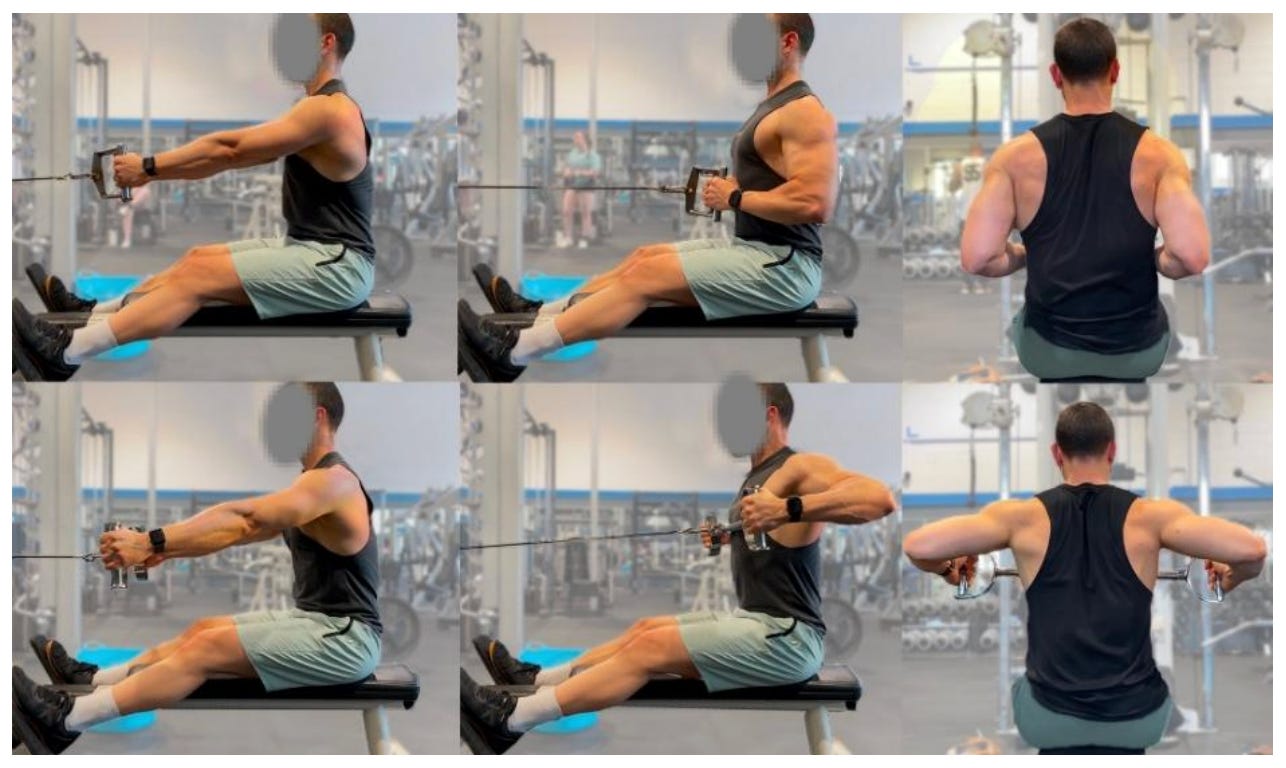
The narrow-SR used a triangle attachment (elbows in, pulling toward the belly). The wide-SR used a straight bar (elbows flared, pulling to the lower chest). Both were performed on a Technogym cable machine.
Figure 1. Narrow grip and wide grip seated row technique.
Results
The narrow-SR consistently produced greater latissimus dorsi activation across both the concentric and eccentric phases. The wide-SR, despite using about 9 kg less, produced greater activation of the upper, middle, and lower trapezius, as well as the lateral deltoid, in both phases. During the eccentric phase only, the wide-SR also produced greater erector spinae activation. The posterior deltoid, biceps brachii, and triceps brachii showed no meaningful difference between grips.