


The question of whether machines or free weights produce superior muscle growth has persisted in gyms longer than it deserves to. Most coaches already operate on the assumption that both tools work, finding first, through experience, that specificity and context are the linchpins first and foremost.
A new randomised within-subject trial by Painelli and colleagues, published in the Journal of Bodywork and Movement Therapies, adds more direct empirical weight to that position. Using ultrasound to track regional hypertrophy across four sites in the vastus lateralis and rectus femoris over 9 weeks, the researchers found no statistically significant difference in quad growth between a free weight lunge and a machine-based inclined leg press. Both legs grew. When volume and effort are matched, the implement is largely irrelevant to the hypertrophic outcome, including, at least in the knee extensors of untrained women.
Aim
The study’s central question was whether free weights and machines drive comparable regional hypertrophy in the knee extensors, or whether one modality preferentially targets specific portions of the muscle. The researchers were interested in where growth occurred, not just whether it occurred, since proximal and distal hypertrophy patterns have practical relevance for programming and rehabilitation contexts.
Methods
The trial used a within-subject contralateral design: each participant trained one leg with free weights and the other with a machine, which neatly controls for the between-subject noise that typically complicates comparisons like this.
Participants: 8 previously untrained women
Free weight exercise: Lunge
Machine exercise: Inclined leg press
Duration: 9 weeks, 3 sessions per week
Measurements: Ultrasound assessed muscle thickness of the vastus lateralis (VL) and rectus femoris (RF) at two femur length sites each: 50% (proximal) and 70% (distal)
Analysis: Mixed model, significance set at p ≤ 0.05


Results
Muscle thickness increased significantly from pre- to post-training at every measured site in both legs. No statistically significant between-condition differences were found at any site.
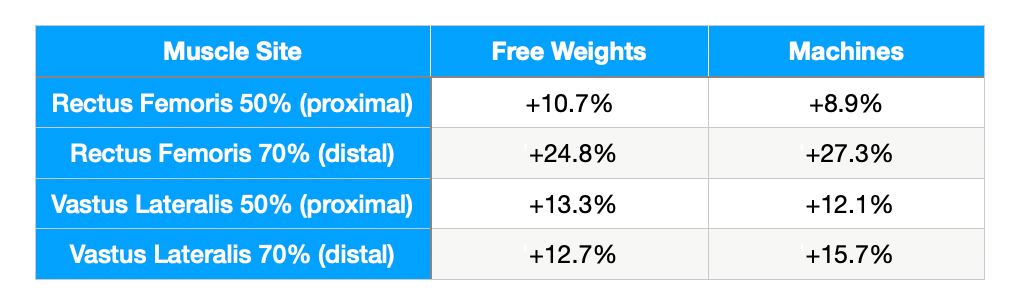
The distal rectus femoris site produced the largest gains under both conditions, which is a detail worth noting for those specifically targeting the lower quad.
Takeaways
Equipment access is not a limiting factor for quad hypertrophy. A leg press and a lunge produced virtually identical results over 9 weeks. Program what you have and what the athlete will execute well.
Regional growth patterns were consistent across both conditions. Neither modality preferentially loaded the proximal or distal quad to a degree that would meaningfully influence programming decisions at this stage of the evidence.
For rehab and clinical settings, machines offer a controlled loading environment without any apparent compromise to the hypertrophic stimulus. That is a useful data point when working around technique limitations or post-injury load management.
Combining both modalities remains a sensible approach for managing volume and variety without sacrificing outcomes.
Know the sample. These were 8 untrained women. Applying these findings directly to trained lifters, male populations, or sport-specific contexts requires caution. More research in those groups is needed before drawing firm conclusions.

Reference
Painelli, V. D. S., Silva, M. V. D. S., Justino, J. C., et al. (2025). Comparable regional hypertrophy of the knee extensor muscles in response to resistance training with machines versus free weights: A randomized within-subject approach. Journal of Bodywork and Movement Therapies, 45, 562–568. https://doi.org/10.1016/j.jbmt.2025.S1360859225003742

You can also find me at dannyleejames.com for stories, personal training insights, and coaching.