


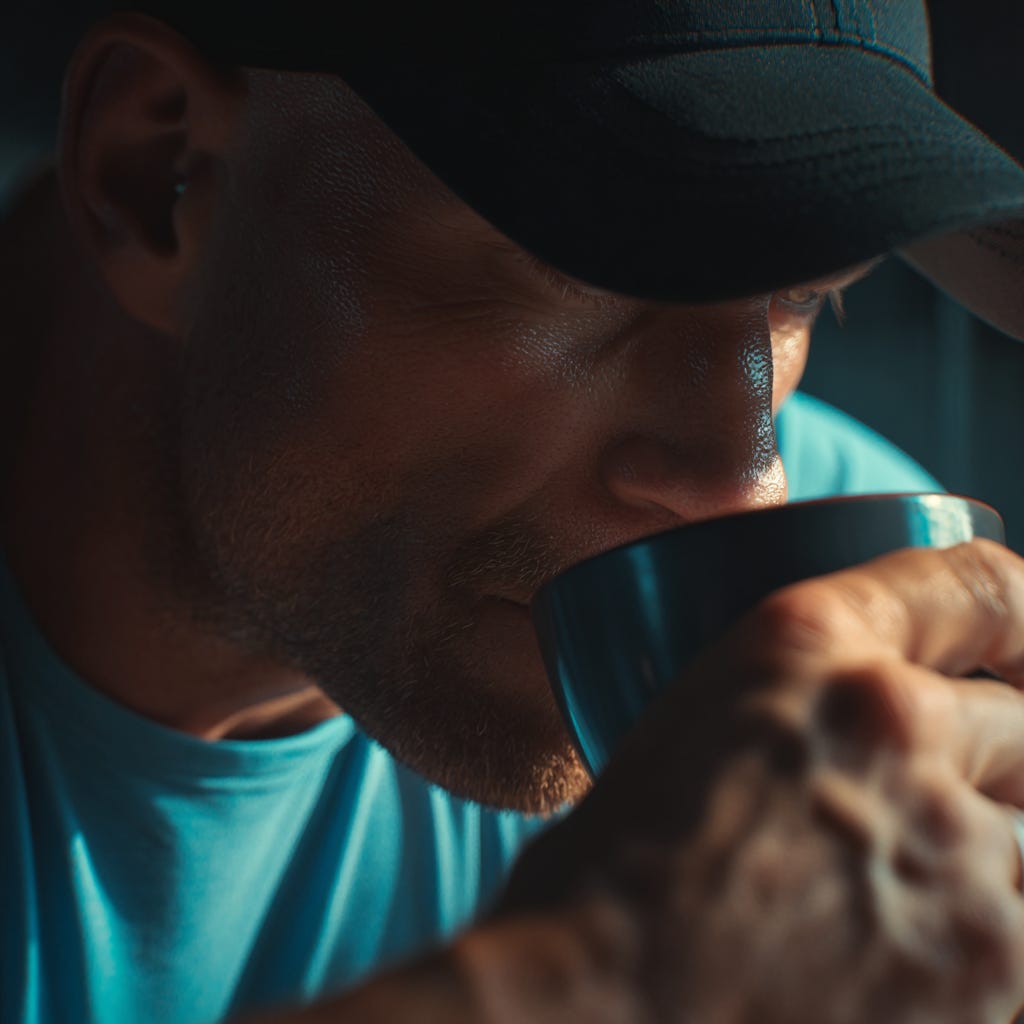
Does that pre-workout coffee actually help you move more weight, or just make you feel wired? This study explored whether high-dose caffeine in real powerlifters, using heavy squats and deadlifts, meaningfully changes bar speed, power, fatigue, and how hard the sets feel.
PMID: 40845293
Key Points
This research tested whether a single high dose of caffeine (8 mg per kg of body weight) improves neuromuscular performance and lowers perceived effort in trained male powerlifting athletes performing back squats and deadlifts across a range of heavy loads.
Sixteen competitive male powerlifters completed two lab sessions one week apart in a randomised, placebo-controlled, quadruple-blind, cross-over design, taking either caffeine or a placebo before lifting, so each athlete served as his own control.
Aim
To assess whether acute caffeine supplementation enhances barbell mean velocity, mean power, and reduces velocity loss (fatigability) and rating of perceived exertion (RPE) during barbell back squat and deadlift at 40, 60, 80, and 90% of 1RM in powerlifting athletes.
The authors specifically wanted to know if caffeine could help maintain bar speed and reduce the perceived effort of the sets, especially at higher loads typically used during peaking.


Method
Participants:
16 male powerlifters (15 completed), age 18–32 years, with at least 2 years of strength training and prior competition experience.
Mean body mass 88.0 ± 14.2 kg, height 176.4 ± 6.3 cm.
Average 1RM: back squat 181.0 ± 44.7 kg (≈2.0 × body mass), deadlift 215.0 ± 38.8 kg (≈2.5 × body mass).
Habitual caffeine intake was about 157.3 ± 110.7 mg per day.
Supplement protocol:
Caffeine condition: 8 mg/kg body mass anhydrous caffeine in capsules (≈640 mg for an 80 kg lifter).
Placebo: identical capsules with maltodextrin, same number of capsules as caffeine.
Capsules ingested 60 minutes before lifting to coincide with peak blood caffeine levels.
Exercise protocol:
Session 1: baseline testing for anthropometrics and 1RM back squat and deadlift following powerlifting technical standards.
Sessions 2 and 3: experimental sessions (caffeine or placebo, randomised order), separated by 1 week.
After the warm-up, athletes performed:
Back squat: 3 reps at 40, 60, 80, and 90% of 1RM, 3–5 minutes rest between sets.
Deadlift: same structure (3 reps at 40, 60, 80, 90% 1RM, 3–5 minutes rest).
Athletes were instructed to perform the concentric phase “as fast as possible” in both lifts.
Measurements:
Bar velocity and power were measured using the My Jump Lab smartphone app, which captured lateral video at 240 fps, recording mean velocity (m/s), mean power (W), and velocity loss (%) within each set.
Velocity loss is calculated as the percentage drop from the fastest to the slowest rep in each set.
RPE was measured after each set using the OMNI-RES resistance training scale.

Book a call with me here.
We’ll sit down and upgrade or build out your entire training and performance program in one session.
Results
Performance
Mean bar velocity (squat and deadlift)
Back squat:
Caffeine significantly increased mean velocity at all loads (40, 60, 80, 90% 1RM) compared with placebo.
Effect sizes were large: Hedges’ g ranged from 1.43 to 3.07 across loads, with the largest effects at 80 and 90% 1RM.
For example, at 80% 1RM, mean squat bar velocity was 0.68 ± 0.03 m/s with caffeine vs 0.58 ± 0.04 m/s with placebo.
Deadlift:
Caffeine also significantly increased mean velocity at 40, 60, 80, and 90% 1RM versus placebo.
Effect sizes were again large (Hedges’ g ≈ 1.31–1.99 across loads).
At 90% 1RM, mean deadlift bar velocity was 0.46 ± 0.02 m/s with caffeine vs 0.41 ± 0.03 m/s with placebo.
Interpretation: With caffeine, lifters moved the same loads faster, and the effect was especially pronounced at heavy loads (80–90% 1RM), which are highly relevant for strength and peaking work.
Mean power output
Back squat:
Significant condition × load interaction; caffeine increased mean power at:
60% 1RM: 1,046.7 ± 250.6 W (caffeine) vs 996.4 ± 264.5 W (placebo).
80% 1RM: 951.7 ± 208.5 W vs 815.6 ± 191.3 W. 90% 1RM: 640.4 ± 161.8 W vs 532.9 ± 122.0 W.
Effect sizes ranged from small to moderate (Hedges’ g ≈ 0.20–0.75).
Deadlift:
No interaction between condition and load, but there was a main effect of condition.
Across all loads, mean power was higher with caffeine than placebo, with Hedges’ g ≈ 0.37, despite no specific load-by-load significance.
Interpretation: Caffeine clearly improved power output in the squat at moderate-to-high loads and modestly increased power in the deadlift overall, even if the pattern by load was less distinct.
Velocity loss (fatigability within sets)
Back squat:
Significant condition × load interaction.
At 80% 1RM:
Caffeine: 12.3 ± 3.1% velocity loss.
Placebo: 16.1 ± 2.9%, with a large effect (Hedges’ g 1.28).
At 90% 1RM:
Caffeine: 28.2 ± 4.9%.
Placebo: 36.3 ± 10.3%, Hedges’ g 1.02.
No meaningful differences at 40 and 60% 1RM.
Deadlift:
Significant condition × load interaction.
At 80% 1RM:
Caffeine: 11.8 ± 2.5%.
Placebo: 15.6 ± 2.4%, Hedges’ g 1.28.
At 90% 1RM:
Caffeine: 19.7 ± 4.5%.
Placebo: 27.2 ± 7.6%, Hedges’ g 1.13.
Again, 40% 1RM showed no meaningful difference in velocity loss.
Interpretation: At heavy loads, caffeine reduced the drop-off in bar speed from the first to last rep, meaning athletes maintained their performance better within the set.
Perceived Exertion and Side Effects
Rating of perceived exertion (RPE)
Back squat:
No interaction with load, but significant main effects of condition and load.
Across all loads, caffeine produced lower RPE than placebo (p = 0.003; Hedges’ g 0.16).
Example at 90% 1RM:
Caffeine: 8.2 ± 1.1.
Placebo: 8.8 ± 0.8.
Deadlift:
No condition × load interaction, but main effect of condition.
Caffeine yielded lower RPE overall than placebo (p = 0.042; Hedges’ g 0.11).
Example at 90% 1RM:
Caffeine: 8.1 ± 1.2.
Placebo: 8.9 ± 0.9.
Interpretation: For the same weights, sets felt slightly easier with caffeine, especially at heavier loads, even though the bar was moving faster and fatigue was lower.
Adverse events and blinding
Some athletes reported tachycardia, headache, and anxiety when asked afterwards which condition they thought they were in, but none reported that these side effects worsened their performance.
Blinding was only partially effective:
53.3% correctly identified the placebo session.
46.7% correctly identified the caffeine session.
Interpretation: The high dose was powerful enough that a notable portion of lifters detected it, which is relevant when thinking about tolerability for everyday training.
Practical Takeaways
For lifters and coaches, here is what this specific study suggests in practical terms:
Dose and timing:
A single, relatively high caffeine dose of 8 mg/kg taken about 60 minutes before training improved bar speed, power, and reduced fatigue in trained male powerlifters.
For an 80 kg lifter, that is around 640 mg, which is considerably higher than a typical “two strong coffees” range.
Where the benefits show up:
Bar speed was faster in both squat and deadlift at all tested loads, with especially large gains at 80–90% 1RM.
Power output increased meaningfully in the back squat at 60–90% 1RM and modestly in deadlift across loads.
Velocity loss within sets at 80–90% 1RM was clearly lower, suggesting better maintenance of performance rep-to-rep under heavy loading.
Perceived effort was slightly lower despite better objective performance.
How this might be used:
Heavy strength or peaking sessions: For advanced male powerlifters, high-dose caffeine could be most useful when performing high-load, low-rep sets in squats and deadlifts, where bar speed and fatigue management matter.
Velocity-based training (VBT): If you use bar speed thresholds to manage fatigue, caffeine might help you sustain higher velocities deeper into sets, potentially altering when you hit your planned velocity cut-offs.
Competition strategy: The findings support the idea that caffeine could be an ergogenic tool for meet day, though this exact study is acute and only in training-like conditions, not on the platform.
Cautions and limitations:
Population: Results apply to competitive, trained male powerlifters, not necessarily to women, untrained individuals, or other sports.
Dose: 8 mg/kg is high and led to reported symptoms like tachycardia, headaches, and anxiety in some participants; lower doses may offer a better risk–benefit balance in practice.
Exercises: Only the back squat and deadlift were tested; bench press and other lifts were not studied here.
Context: Nutrition was reported but not tightly controlled, and only acute effects were measured—no data on long-term adaptations or chronic use.
For a competitive male powerlifter who tolerates caffeine well, a high pre-session dose taken an hour before heavy squats and deadlifts can make the same weight move faster, feel slightly easier, and lead to less drop-off in bar speed across reps—especially in the 80–90% 1RM range that is common in strength and peaking blocks.

Key Takeaways
A single 8 mg/kg dose of caffeine 60 minutes pre-training improved mean bar velocity in both squat and deadlift at 40–90% 1RM in competitive male powerlifters.
Caffeine increased mean power in the back squat at 60–90% 1RM and produced a general increase in deadlift power across loads.
At high loads (80–90% 1RM), caffeine reduced velocity loss within sets in both lifts, indicating less performance decline rep-to-rep.
RPE was lower with caffeine despite higher objective performance, suggesting reduced perceived effort at a given load.
The dose used is high, and some athletes reported side effects, so while the ergogenic effect is clear in this study, dose and individual tolerance need careful consideration in real-world programming.
Reference
Enes A, Hubner P, Oneda G, Bernardo MF, Macedo ACG, Salles GN, Ferreira LHB, Rezende EF, Mohan AE, Piñero A, Leonel DF, Cruz R, Schoenfeld BJ, Souza-Junior TP. Effects of Caffeine Supplementation on Neuromuscular Performance in Powerlifting Athletes: A Randomised, Placebo-Controlled, Quadruple-Blinded, Cross-Over Study. J Strength Cond Res. 2025 Aug 13. doi: 10.1519/JSC.0000000000005222. Epub ahead of print. PMID: 40845293.

You can also find me at dannyleejames.com for stories, personal training insights, and coaching.