


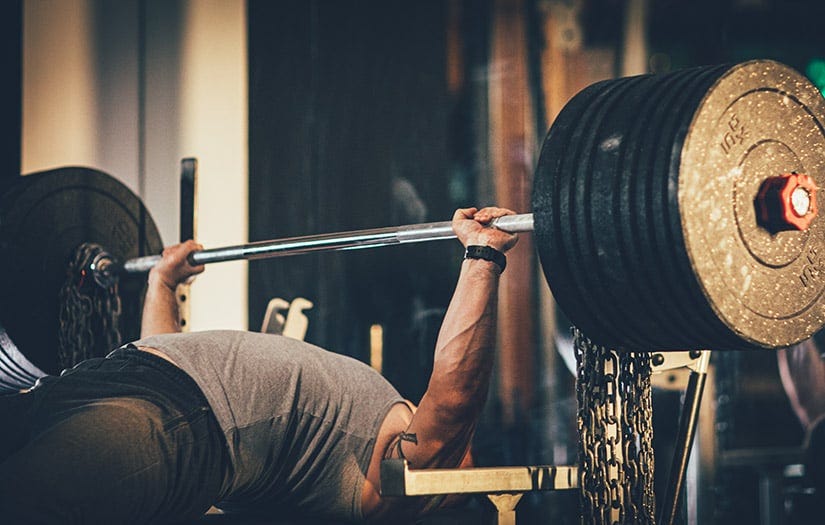
Researchers tested whether overloading the lowering phase of bench presses with maximal or supramaximal weights improves the lifting phase power, force, and speed. They used weight releasers on 18 trained men doing reps at 40-80% of their one-rep max. They found the type of eccentric load made little difference to concentric performance. Load size mattered more, with lighter loads speeding up the bar and heavier ones building force. This shows that accentuated eccentric loading may not always enhance bench press output, especially for lifters with moderate strength.
Aim
The study aimed to check the acute effects of maximal (100% of concentric one-rep max) and supramaximal (110%) accentuated eccentric loading versus traditional loading on bench press power, force, velocity, and eccentric duration. They wanted to see if weight releasers during the eccentric phase boost concentric metrics across loads from 40 to 80% one-rep max in trained men with a relative strength of 1.27 kg per kg body mass.
Methods
Eighteen men aged 24, 180 cm tall, 96 kg, with 2+ years training and bench one-rep max around 121 kg took part. After one-rep max testing and weight releaser familiarisation, they did three sessions: traditional loading, AEL100, and AEL110, in random order with 7-96 hours rest between. Each session had three reps per concentric load (40, 50, 60, 70, 80% one-rep max), three minutes rest between sets. A linear position transducer measured mean and peak power, velocity, force, and eccentric repetition duration. Stats used repeated measures ANOVA with post-hoc tests and Cohen’s d effect sizes.


