

Does Adding Eccentric Reps After Reaching Concentric Muscle Failure Build More Muscle?
Is the eccentric-reserve a thing worth training?

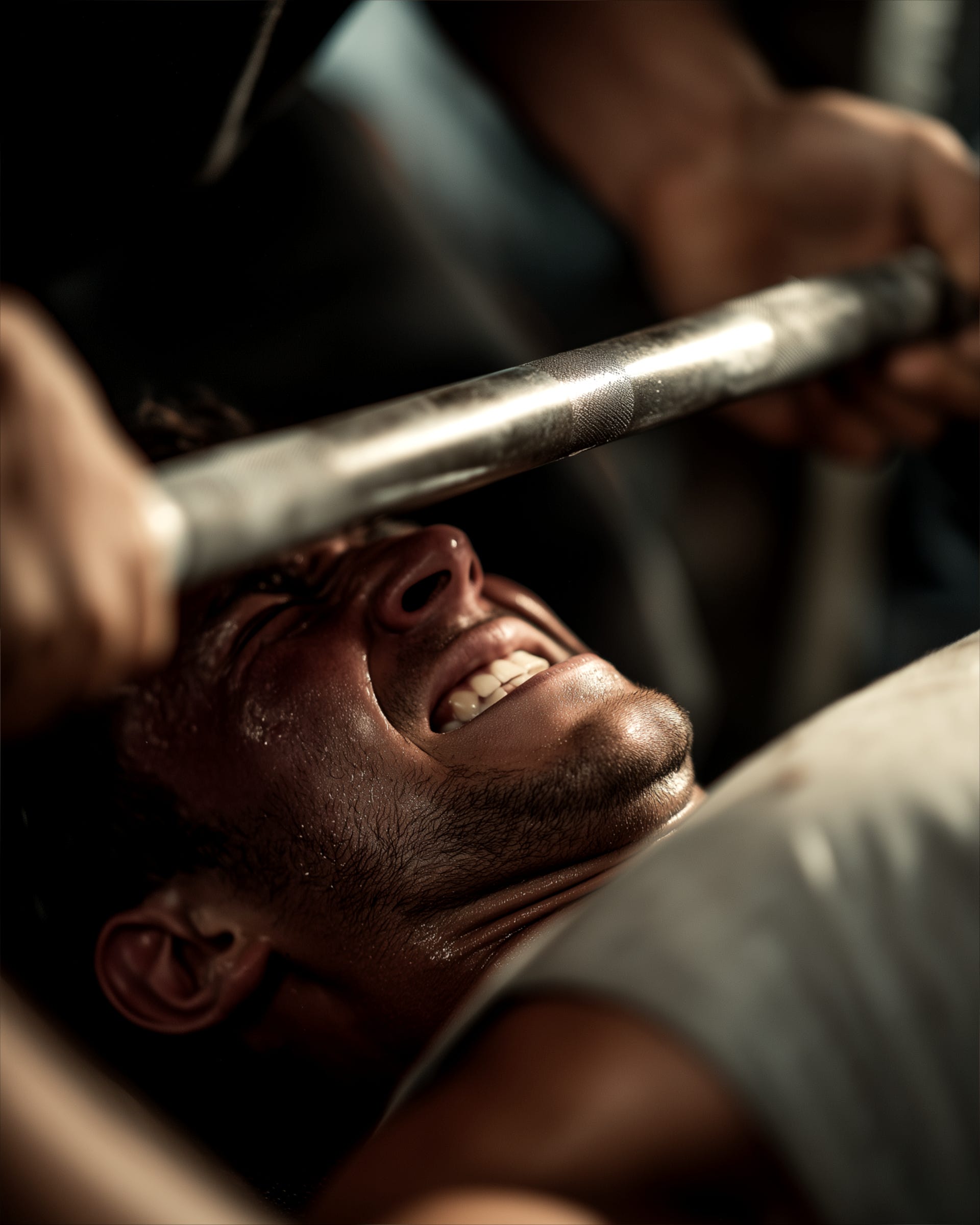
Most lifters train to the point where they can no longer lift the weight, call it a day, and move on. But what if that moment isn't actually the end of your muscle's capacity? A new study from the University of São Paulo asks: After you've reached concentric failure (the point where you can't complete the lifting phase), your muscles can still resist the load on the way down. This trial aims to find out whether pushing all the way to eccentric failure as well, to the point where you can no longer even control the lowering phase, produces meaningfully greater gains in muscle size and strength than stopping at concentric failure alone.
Aim
The central question is whether adding eccentric-only contractions to failure, after concentric failure has already been reached, produces greater strength and hypertrophy adaptations than a traditional set that stops at concentric failure.
The researchers outline three specific objectives: compare total training volume load produced per session between the two protocols; compare chronic changes in muscle size (including regional hypertrophy at multiple sites along the arm); and compare improvements across all major strength qualities, including isometric, concentric, and eccentric strength. The study is focused exclusively on untrained young women, which the team notes is a population significantly underrepresented in resistance training research.
Methods
This is a within-participant randomised trial, meaning each participant serves as their own control. Untrained women aged 18 to 30 with no upper-body resistance training experience in the past six months will be recruited. Each participant performs both training protocols simultaneously across 10 weeks, one on each arm, with the arm-to-protocol assignment randomised electronically for each person.
Both arms train twice per week, with a minimum of 48 hours and a maximum of 96 hours between sessions. Each session consists of 6 sets of unilateral elbow flexion on a preacher curl bench, using a load in the 9 to 12 repetition maximum range and a strictly controlled 2-second up / 2-second down tempo via metronome. Rest between sets is 2 minutes, with range of motion standardised to 100 degrees using a physical barrier.
The two protocols are:
TRAD: Sets taken to concentric failure (MFCON), the point where the participant can no longer complete the lifting phase within the 2-second window.
ECC+: The same sets to concentric failure, followed immediately by additional eccentric-only contractions (the researcher assists the lifting phase) until eccentric failure (MFEXC) is reached — the point where the participant can no longer control the lowering phase.
For the ECC+ protocol, volume load calculations account for the eccentric-only reps by multiplying them by 0.5, reflecting that they represent only half the full contraction cycle.

Pre- and post-intervention assessments include:
Muscle size: Biceps brachii and brachialis thickness via ultrasound at three sites (proximal, middle, and distal, measured at 50%, 60%, and 70% of arm length), plus arm lean mass via DXA scan.
Strength: Peak isometric torque and rate of torque development at two elbow angles (60 and 90 degrees), and peak isokinetic concentric and eccentric torque, all measured on a Biodex isokinetic dynamometer.
Session load: Volume load per session plus perceived effort via the OMNI RPE scale after each set and 15 minutes after the session.
A power calculation determined that a minimum of 11 participants (21 upper limbs) is required to detect meaningful differences in muscle thickness.