


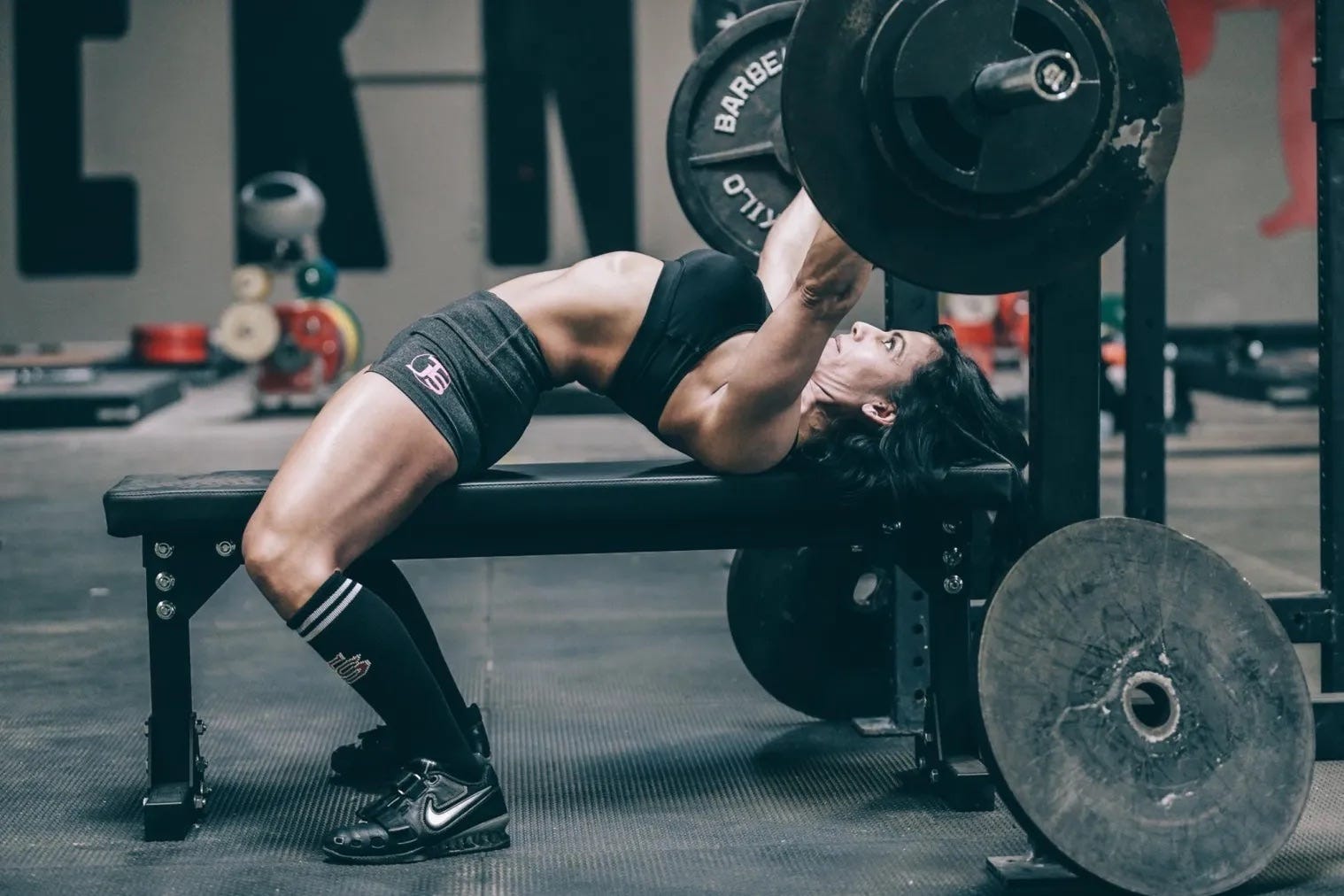
Researchers from the University of Seville and Universidad Pablo de Olavide recruited 49 intermediate-trained women and put them through an 8-week bench press program, training twice a week at heavy loads (70–85% of 1RM). The women were split into three groups that trained identically in every way, only differing in when a set was terminated. One group did just a single rep per set. A second group stopped when bar speed had dropped 25% from their first rep. The third pushed until bar speed had dropped 50%, getting close to muscular failure.
The researchers measured everything: 1RM strength, explosive force production, muscle size in the triceps, bar velocity across the full load spectrum, and electrical muscle activation. What they found confirmed a growing suspicion in the field. Women appear to need more volume and more within-set fatigue than men to maximise strength and hypertrophy gains, and the right fatigue threshold depends entirely on what you are training for. Pushing harder built more muscle and strength. Stopping at a moderate threshold built the best explosive and neural qualities. And doing just one rep per set, while not useless, left significant gains on the table.
Aim
Most VBT research has been conducted on men, yet we routinely apply those findings to female athletes and lifters. Prior work had already hinted that women may need higher velocity loss (VL) thresholds than men to drive the same adaptations, particularly in the bench press. This study set out to directly compare three VBT conditions in the bench press using heavy loads (70–85% of 1RM), testing whether training to different levels of within-set fatigue would produce meaningfully different outcomes in strength, hypertrophy, and neuromuscular function in women.


Methods
Forty-nine intermediate-trained women (average age 21.4 years, body mass 61.3 kg, bench press relative strength ~0.53 kg/kg of bodyweight) were randomly assigned to one of three training groups:
VL0: One repetition per set (0% velocity loss)
VL25: Sets taken to ~25% velocity loss (roughly 40–50% of possible repetitions)
VL50: Sets taken to ~50% velocity loss (roughly 75–85% of possible repetitions)
All groups trained twice per week for 8 weeks (16 sessions total), using the same load range of 70–85% 1RM and three sets per session, with four minutes’ rest between sets. A linear velocity transducer tracked bar speed in real time, so intensity was adjusted each session to maintain the prescribed velocity, keeping load relative to each participant’s current level.
Before and after the intervention, researchers assessed triceps brachii (TB) muscle thickness via ultrasound, maximal isometric force and rate of force development (RFD), a progressive loading test to estimate 1RM and load-velocity profiles, and a repetitions-to-failure fatigue test. Surface electromyography (EMG) recorded muscle activation throughout.
The volume performed by each group differed substantially. VL0 completed just 48 total repetitions across the program, VL25 completed 182, and VL50 completed 309.

Results
Every group got stronger. All three groups showed significant improvements in 1RM, velocity against all loads, and muscular endurance, confirming that even minimal-volume training (one rep per set) builds strength in trained women.