



A 2024 study recruited 30 advanced-to-elite male climbers and split them into four groups: eccentric training, plyometric training, isometric training, and a control group that received no additional training to improve climbing performance. For five weeks, twice a week, each group performed pull-ups on a force-sensing hangboard using their assigned method. Before and after, every climber was tested for maximum strength, power output, body coordination, and muscular endurance.
The findings were pretty clear. Eccentric training - slow, controlled lowering at 95% of 1-rep max, produced the biggest gains in power and range of motion. Plyometric training - explosive, consecutive pull-ups with brief hand releases off the bar- was the only method that significantly improved muscular endurance. Isometric training, the lock-off drills beloved by climbers worldwide, largely disappointed, most likely because bodyweight loads are too light to drive the adaptations that isometric training is theoretically capable of producing.
Every training group got stronger. But what that strength looked like, and how useful it would be on the wall, depended entirely on how they trained to build it. Let’s get into it.
Aim
Sport climbing demands a unique combination of finger endurance, explosive arm power, and the ability to resist fatigue through repeated lock-offs and dynamic moves. While finger-specific training has been studied extensively, arm-specific training has never been properly quantified or compared by contraction type.
This study looked at which of three contraction-based pull-up training methods (eccentric, isometric, or plyometric) produced the greatest improvements across the key pull-up capabilities relevant to climbing: maximum strength, concentric muscle power, body coordination, stretch-shortening cycle (SSC) performance, and muscular endurance.
Methods
Thirty male climbers (mean age 24.7 years, body mass 66 kg, IRCRA climbing grade ~23) completed the study after 11 of the original 41 dropped out due to illness or personal issues. They were randomly assigned to one of four groups:
Eccentric (ECC, n=8): Slow lowering phase at 95% of 1-rep max (1-RM), taking 5 seconds per descent, followed by explosive concentric jumps at bodyweight. Six sets per session, 10-second rest between reps, 3-minute rest between sets.
Plyometric (PLYO, n=6): Explosive, consecutive pull-ups at bodyweight with brief hand releases off the bar at the top — small rebounds to maximise stretch-shortening cycle contribution. 7 to 11 reps per set, six sets, 3-minute rest.
Isometric (ISO, n=7): Lock-offs held for 7 seconds at three different elbow angles (60°, 90°, and 120°), combined with explosive concentric jumps, all at bodyweight. Six sets, 3-minute rest between sets.
Control (CTRL, n=9): No arm-specific training added.
All training was done on a SmartBoard force-sensing hangboard using the largest holds to eliminate finger strength as a limiting factor. Sessions ran twice a week for five weeks.
Pre- and post-testing used three pull-up variations — Strict (arms only), Normal (with hip/leg coordination), and Countermovement (adding a downward phase before pulling) — along with incremental weighted pull-ups to establish the force-velocity (F-V) relationship, and a pull-up exhaustion test for endurance.


Results
Maximum Strength
All three training groups improved 1-RM compared to the CTRL group (p<0.001), with the ECC group showing the largest gain (+5.0 ± 2.4 kg), followed by PLYO (+3.2 ± 2.2 kg) and ISO (+2.2 ± 3.6 kg). The CTRL group barely moved (+1.5 ± 3.2 kg).
Power and Velocity (Strict Pull-Up)
The ECC group significantly outperformed the CTRL group in mean power (+12.0%), mean velocity (+9.7%), peak velocity (+5.7%), and range of motion (+12.1%). The PLYO group showed a significant increase in mean velocity (+7.7%) but no change in range of motion. The ISO group produced no significant changes in the Strict pull-up at all.
Body Coordination (Normal Pull-Up)
Here the picture sharpened considerably. Both the ECC and PLYO groups showed much larger peak power gains during the Normal pull-up (which allows hip and leg coordination) than in the Strict pull-up alone — +21.1% and +25.3% respectively — suggesting meaningful improvements in whole-body coordination during the pull, not just raw arm strength. The ISO group again showed minimal benefit.
Stretch-Shortening Cycle (Countermovement Pull-Up)
No group produced statistically significant SSC improvement, though the ISO group showed the largest peak power tendency here (+15.6%), suggesting it may have some application for neuromuscular pre-activation and SSC development over a longer training timeline. The authors note that five weeks is likely too short to see meaningful SSC adaptation.
Muscular Endurance (Exhaustion Test)
The PLYO group significantly increased total energy expended during the exhaustion test by 21.9 ± 16.6% — more than the ECC (+10.1%) and ISO (+13.3%) groups (p=0.015). The consecutive, explosive nature of plyometric pull-ups — performed with minimal rest between reps within a set — appears to be the key driver of this endurance adaptation.
Key Takeaways
Here is how each method stacks up for different training goals:
Eccentric training led all methods for power output and range of motion, while plyometric training was the only approach to significantly improve muscular endurance.
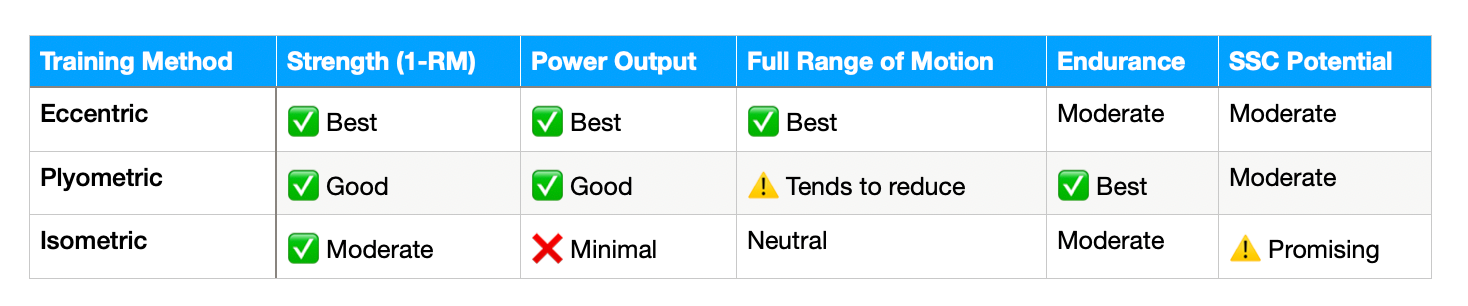
If power is the priority, eccentric training at high load (95% 1-RM) is the clear choice. It improved both raw strength and coordinated power across a full pull-up range of motion, which is directly relevant to real climbing movement.
If endurance is the priority, plyometric training wins decisively, likely because consecutive explosive reps with short intra-set rest better replicate the fatigue demands of climbing.
Plyometric training has a trade-off: it tends to reduce the pull-up range of motion, because climbers keep a slight elbow bend at the bottom to optimise rebound efficiency. For climbing, where full arm extension is often required, this is worth monitoring.
Isometric training underperformed — most likely because bodyweight lock-offs only load the muscles at roughly 55 to 75% of 1-RM. The existing literature suggests 80 to 100% of 1-RM is needed to drive meaningful isometric strength gains. At the right load, isometric training may prove more valuable, particularly for SSC and neuromuscular pre-activation.
Five weeks is enough to see real changes. Gains of 5 to 21.9% were achieved across measures in just 10 sessions total — a strong return for a relatively short block of arm-specific work.
High inter-individual variability was observed, meaning initial strength level, climbing history, and individual recovery all influence how much someone responds to any given method. Coaches should treat these results as a framework, not a formula. The key principles of specificity, overload, and fatigue management always apply.

Reference
Vigouroux L, Devise M. Pull-Up Performance Is Affected Differently by the Muscle Contraction Regimens Practised during Training among Climbers. Bioengineering. 2024; 11(1):85. https://doi.org/10.3390/bioengineering11010085

You can also find me at dannyleejames.com for stories, personal training insights, and coaching.