

Complex vs. Contrast Training: Which One Builds Better Athletes?
New research on elite track athletes shows how the two methods build power and eccentric strength differently.

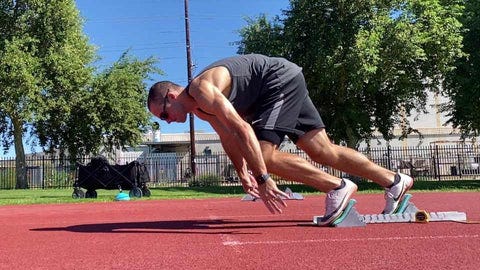
A 24-week trial on elite track and field athletes found that complex training and contrast training both improve explosive power, but they do it in different ways and for different purposes. Complex training built more jump height and eccentric strength. Contrast training made athletes faster off the ground. These findings give coaches a clear, evidence-based framework for choosing the right method based on an athlete's strengths and their sport's demands. Let’s dive in.
Aim
Researchers from Jimei University in China wanted to know which of two popular training methods, complex training or contrast training, was better for building lower-body explosive power and eccentric strength in elite athletes over the long term. They also examined whether arm swing plays a meaningful role in jump performance and whether eccentric strength could predict jump height.
Methods
Forty-five national-level male track and field athletes were randomly split into three equal groups of 15: a complex training group, a contrast training group, and a control group. All groups trained three 90-minute sessions per week for 24 weeks.
The complex training group paired heavy resistance work with plyometrics using short 1-3 minute rest periods between exercises, designed to take advantage of postactivation potentiation (PAP), the brief window after heavy lifting where the neuromuscular system is primed for explosive output.
The contrast training group used a similar pairing of heavy and explosive work, but with much longer rest periods of 4-10 minutes between exercises. This design targets postactivation performance enhancement (PAPE), a more sustained improvement in voluntary performance after maximal loading.
The control group followed the university’s standard strength and conditioning program, including traditional squats, sled sprints, and core work.
Jump performance was tested at baseline, week 12, and week 24 using a 3D force plate. Athletes were tested in both arm-swing and no-arm-swing conditions to isolate how much the upper body contributes to jump mechanics.


Results
Both training methods produced meaningful gains, but there were important differences.