


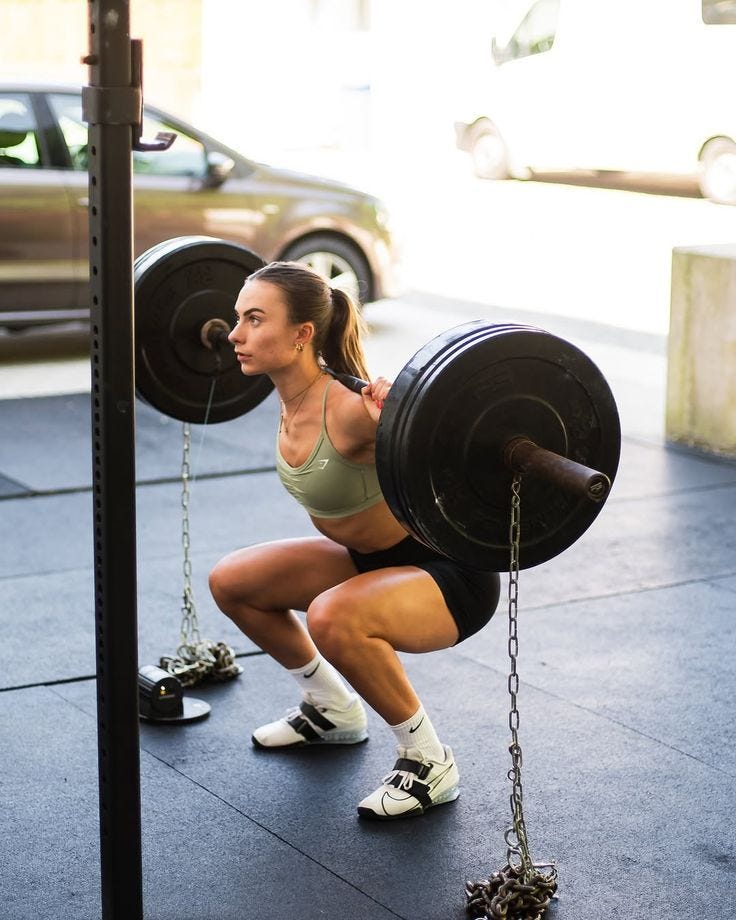
New research out of James Cook University compared three versions of the barbell back squat: free weights, chains, and elastic bands, and found that the type of resistance you use changes what happens at the hip and spine far more than it changes what happens at the knee. For coaches working with athletes managing lower back issues or those chasing power output, these findings offer a clearer picture of which tool to reach for and when. Let’s look a little closer.
Aim
Researchers wanted to know how chains (CVR) and elastic bands (EVR) change the forces and movement patterns at each joint during the squat compared to a standard free-weight load. Most prior research had only looked at barbell speed and ground reaction force, and nearly all of it focused on bands only. This study went deeper, examining what happens at the ankle, knee, hip, lumbar spine, and lumbopelvis throughout both the lowering and lifting phases.
Methods
Fifteen trained men with an average squat 1RM of 124 kg completed five sessions over four weeks. After a 1RM test and a familiarisation session, they each performed one testing session per resistance condition in a randomised order. Every session used 80% of 1RM as the total load. For the variable resistance conditions, 20% of that load came from the chains or bands, with the remaining 60% on the bar. Subjects squatted to 115 degrees of knee flexion, and motion capture, along with force plates, collected detailed joint-level data. Kinetic and kinematic data were pulled from the second rep of each set.


Results
Repetitions completed varied considerably. Subjects averaged about 10 reps with free weights, 13 with chains, and 17 with bands. The lower effective load at the bottom of the squat allowed more reps across both variable resistance conditions.
Ground reaction force was highest with free weights. Both bands and chains produced lower peak ground reaction force, which reflects the reduced load at the bottom of the squat in both variable resistance conditions.
Rate of force development during the mid-concentric phase was significantly higher with chains than with free weights. Bands did not differ from free weights on this measure, which was an unexpected finding given that bands are often assumed to offer a power advantage through their elastic recoil effect.
Angular velocity was faster across the ankle, knee, and hip during both the lowering and lifting phases with bands and chains compared to free weights. Both variable resistance conditions moved similarly to each other in terms of speed.
Joint range of motion was the same across all three conditions at every joint. The type of resistance did not change how deep or how far subjects moved.
Joint moments at the ankle and knee were similar across all three conditions. Despite the load differences, the increased speed of movement with variable resistance compensated, producing comparable demand on the quads and calves.
Hip, lumbopelvis, and lumbar spine moments told a different story. Free weights produced significantly greater demand at these joints than both bands and chains during both the lowering and lifting phases. When comparing the two variable resistance types, chains produced greater hip, lumbopelvis, and lumbar spine moments than bands.
Joint power at the knee was greater with both bands and chains compared to free weights. At the hip, only chains produced greater power than free weights. Bands did not significantly increase hip power over free weights.

Practical Takeaways
The most actionable finding here is the split between what happens at the knee versus what happens further up the chain. Both bands and chains maintain similar knee-level stimulus to free weights, while reducing the load on the lower back. For athletes managing spinal injury or those with a history of lower back issues, bands in particular offer a way to keep training the legs hard without adding spinal stress.
For power development, chains appear to be the stronger option. The linear increase in load during the concentric phase with chains produced a greater rate of force development and greater hip power; bands did not match these advantages. The researchers suggest a logical progression for lifters: start with bands, move to chains, then progress to free weights, since each step increases demand further up the kinetic chain.
The study did not find clear evidence that either type of variable resistance augmented the stretch-shortening cycle at the point of the eccentric-to-concentric transition. The faster eccentric velocities with variable resistance may still carry SSC benefits, but the data could not confirm this definitively.
The main limitation is that only men were tested, and women are known to use different movement strategies during the squat, so these findings may not apply universally.
Reference
Alves, Adon V; Leicht, Anthony S; Deakin, Glen B; Doma, Kenji; Singh, Utkarsh; Brice, Sara M. Joint-Level Analysis of the Barbell Back Squat During Chain and Elastic Variable Resistance Use. Journal of Strength and Conditioning Research 40(5):p 511-518, May 2026. | DOI: 10.1519/JSC.0000000000005353

You can also find me at dannyleejames.com for stories, personal training insights, and coaching.