



New research on elite youth players reveals that high-load strength training, working at 70-85% of maximum capacity across 12 weeks, can slash injury rates by nearly 90% while simultaneously improving speed, power, and agility. This should come as no surprise, but let’s look at what they did.
PMID: 40289456
Overview
This randomised controlled trial examined whether a 12-week high-load strength training program could reduce injury rates and improve physical performance in 20 highly trained male soccer players aged 17-18 years competing in Spain’s Division de Honor under-18 league. Players were randomly divided into two groups: an experimental group that performed high-load strength training twice-weekly in addition to regular soccer training, and a control group that only completed their normal soccer sessions.
Training Protocol
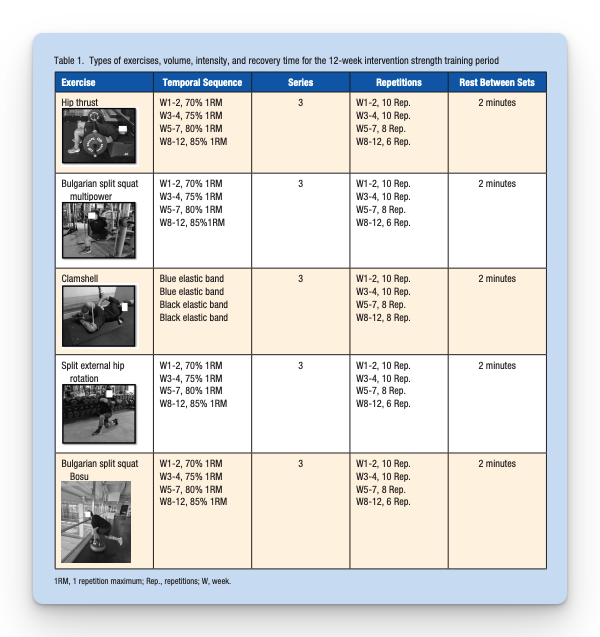
The experimental group completed 24 strength sessions over 12 weeks, training twice per week on non-consecutive days for 45-50 minutes after regular soccer practice. The program featured five exercises targeting the glutes and hamstrings: barbell hip thrusts, Bulgarian split squats on a Multipower machine, clamshells with resistance bands, split with external hip rotation, and Bulgarian split squats on a Bosu ball. Training intensity progressively increased from 70% of one-repetition maximum (1RM) in weeks 1-2, to 75% in weeks 3-4, to 80% in weeks 5-7, and finally to 85% in weeks 8-12. Repetitions decreased as intensity increased: 10 reps in weeks 1-4, 8 reps in weeks 5-7, and 6 reps in weeks 8-12, with 3 sets per exercise and 2-minute rest periods.
Injury Results
The results showed dramatically lower injury rates in the strength training group. The control group experienced 11.34 injuries per 1,000 hours of exposure compared to just 1.31 injuries per 1,000 hours in the experimental group—an 8.6-fold difference. Even more striking was the injury burden: the control group lost 304.66 days per 1,000 hours of exposure versus only 19.72 days in the experimental group, a 15.5-fold reduction. Over the 12 weeks, the control group suffered 7 injuries resulting in 188 total absence days (ranging from 18-58 days per injury), while the experimental group had only 1 injury, causing 15 days of absence. The control group’s injuries included 2 hamstring strains, 2 hip adductor injuries, 1 hip flexor injury, 1 quadriceps injury, and 1 knee ligament injury. During the second half of the intervention (weeks 7-12), the experimental group sustained zero injuries while the control group suffered 3 additional injuries.


